




From Small-Town Hi-Fi to Hip-Hop’s Biggest Names: The Story of Sound Engineer Guénolé Georgelin
 Story by:
Music Blog
Story by:
Music Blog
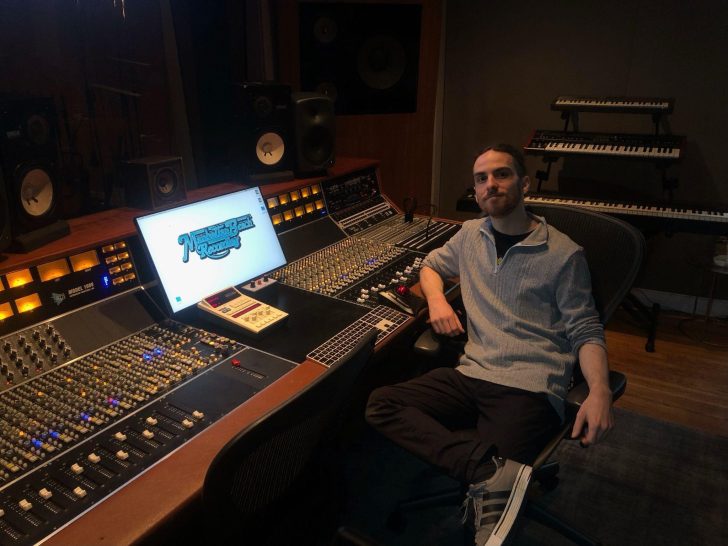
There is a moment Guénolé Georgelin still remembers clearly. When he was twelve years old and helping his father build hi-fi speakers and amplifiers in the western French countryside, he heard loud music playing nearby. He watched the speaker cones move in and out, almost as if the music itself was breathing. “I started getting interested in how a speaker works, how electricity flows in an amplifier, or a guitar, how it can be converted to sound,” he remembers. His curiosity would take him from France to New York and into professional recording studios. Eventually, he found himself in rooms connected to some of East Coast hip-hop’s most influential names, where technical curiosity naturally met the craft of recorded sound and the broader culture of modern music production.
Learning to Listen
Always fascinated with music and how it could be made physical, Georgelin had no local scene to grow up in. The entry to the music business was via guitar lessons and hi-fi work done by his father for iconic albums. When he started his studies at ESRA (École Supérieure de Réalisation Audiovisuelle), located in Paris, in 2018, the change could not be more apparent. “I transitioned from being the only sound freak among my peers in high school to hanging around others similar to me within a year’s timeframe,” he explains. However, passion is not always enough in the recording business. Those who dedicate additional hours get rewarded accordingly. Georgelin was determined to make such extra effort, working on audio mixes and recordings while on film sets, attending sessions alongside graduating students, and seeking internships to develop meaningful connections.
That was how his first credits came about, namely, being the re-recording mixer for Jerkyflow in 2021 and sound supervisor for Ruby Sheila in 2023. His first year of the final ESRA program spent in New York proved to be crucial. Less than half a year after his internship at one of the best studios for recording rap and R&B, Manhattan Beach Recording Studios, he was already considered good enough to be offered employment, becoming an engineer by 2024. Among the most significant: recording Nas on “The Omerta,” his recent feature with Raekwon, and engineering instrumentals on tracks from Mobb Deep’s Infinite.
The Film Sets Came First
Before entering the music scene entirely, Georgelin created a reputation in film audio. The earliest known credit in his career was being a re-recording mixer on Jerkyflow, a 2021 film short by Adnane Rami. The short has since garnered official selections for Venezia Shorts, Paris Play Film Festival, and Faten Hamama Festival, as well as winning at Anglet Short Film Festival in 2022. For his next big project, he traveled to New York. Working with Antoine Zimmermann, he became the sound supervisor for Ruby Sheila. The film won at the NY Independent Cinema Awards 2023 and was an official selection of the Silicon Valley Queer Festival.
New York Changed the Path
After Ruby Sheila, Georgelin began moving toward the music industry. He became part of one of New York City’s important spaces for rap and R&B recording when he joined Manhattan Beach Recording Studios in Brooklyn as an intern. In 2024, he started working as an engineer in the studio. The function of Georgelin is primarily to ensure that the choice of microphones is accurate, although there is more to it than meets the eye.
Sometimes it becomes a case of mixing under stress, and other times, it is about designing a space in which the artist can be comfortable enough to perform organically. This combination of technical skill and artistic sensibility has led him to some important projects in the field. Some of his major accomplishments include his work with rapper Nas in “The Omerta,” his contribution to the rap collaboration with Raekwon, and engineering instrumentals for songs by mob deep’s album “Infinite.”
Translating an Artist’s Vision
Ask Georgelin what makes a strong engineer, and he starts with interpretation. “The most important skill I bring to the table is being a listener,” he says. “I always try to translate the artist’s vision to the speaker via my mixing software or whatever gear I have in hand.” A recording engineer often works between feeling and technique. An artist may not describe a track in technical terms. They may describe a mood, an era, a memory, or a reference song. Georgelin has to understand what they mean and know how to get there. “If an artist is in the studio for two hours and needs a track mixed from raw to streaming-ready, there’s no time to make a plan,” he says. “You need to jump straight into it.” He also watches how artists respond to his music. “If artists don’t respond to my track, I know I still need to do more work.”
The Human Element in a Changing Industry
Streaming has changed not only how music is released during stadium shows but also how it’s consumed by people. Remote sessions have become a normal part of studio life, and AI tools are entering all areas of production. Georgelin is realistic about those changes and thinks AI tools are helpful to speed up the workflow, but they shouldn’t be used to replace human judgment. He believes most artists want someone who can read the room, interpret notes, and hear what’s missing.
Passing It On
Last year, Georgelin returned to ESRA in a different role. The school invited him to serve as a jury member for final-year student films, alongside professionals including Albert Rudnitsky, dialogue consultant on Sean Baker’s Palme d’Or-winning Anora, and Emmy Award-winning cinematographer Olivier Sarbil. For someone who had arrived at ESRA from a small town with no real music scene, the invitation meant something. Whereas he had once been a student, he was now being asked to evaluate the next generation of filmmakers and sound professionals. At Manhattan Beach, Georgelin teaches his students how to set up microphones, use Pro Tools, and work with preamplifiers. They also have the opportunity to immerse themselves in the practicalities of studio life.
Still at the Beginning
Eight years down the line, and Georgelin is just beginning, that much at least he will let you know. “I used to believe that one had to grow up in big cities among the studios and the musicians to be able to have a good start in this business,” Georgelin states. “My career journey is an illustration of the contrary.” That person who once hailed from a small town and was not exposed to anything about the music world for some time has now created a portfolio all by himself, without having been too concerned about achieving milestones too quickly. What matters most to him currently is working hard with recording, mixing, and making sessions memorable.
Connect with Guénolé Georgelin on LinkedIn.



Comments 0
No Readers' Pick yet.